
Bakery Management Software: The Complete 2026 Small Business Guide
What if the most important tool in your kitchen wasn't your heavy-duty stand mixer, but a digital system that guaranteed a predictable profit on every crumb? Many boutique bakers spend more time hunting for lost client notes and manually calculating ingredient costs than they do actually decorating. You likely started your business to create art, yet you've found yourself trapped in a cycle of underpricing cakes and losing hours to shopping lists. It's a common hurdle that often leads to burnout rather than the thriving creative life you imagined.
This guide demonstrates how specialized bakery management software transforms that administrative weight into a streamlined, professional workflow. By the end of this article, you'll understand how to reclaim your time and ensure every order is priced for growth. We'll examine the latest 2026 industry trends, compare the best tools for small-scale operations, and show you how to professionalize your client experience to drive repeat bookings effortlessly.
Key Takeaways
- Understand how dedicated bakery management software replaces the limitations of generic spreadsheets to capture the true cost of every order.
- Explore the four operational pillars that prevent administrative bottlenecks and keep your client details organized in one central hub.
- Learn to evaluate software based on the unique needs of a solo creator rather than the complex requirements of industrial factories.
- Master a five-step transition plan that starts with auditing your current process and ends with a fully automated shopping list.
- Gain the confidence to price your work accurately by using professional tools like labor timers to account for every minute spent in the kitchen.
What is Bakery Management Software for Small Businesses?
Think of bakery management software as the digital backbone of your boutique shop. It is a specialized ecosystem designed to handle the intricate logistics that general business tools simply cannot grasp. While a standard spreadsheet might track a simple list of ingredients, it rarely accounts for the fluctuating costs of premium butter or the specific labor minutes required to pipe a complex floral design. This software bridges the gap between your creative vision and the cold reality of profitability.
If you rely on generic tools like Excel, you likely find yourself manually updating prices or losing track of client allergies across multiple tabs. These systems fail because they weren't built for the "messy" reality of a kitchen. Transitioning to a dedicated digital workflow transforms administrative tasks from a heavy burden into a streamlined part of your creative process. It allows you to move away from reactive "firefighting" and toward proactive business growth.
The Evolution from Paper Logs to Digital Systems
Avoid the "Paper Trap" at all costs. Scrawled notes on flour-dusted order books are a liability that leads to missed deadlines and lost revenue. In 2026, the "Digital Kitchen" has become the standard for boutique brands that value precision. Having a single source of truth for every order provides a profound psychological benefit. It eliminates the 2 AM anxiety of wondering if you remembered to buy that specific brand of fondant. When your data is centralized, you gain the mental clarity needed to focus on the artistry of your craft.
Industrial ERP vs. Boutique Management Tools
Large-scale operations often use Enterprise Resource Planning (ERP) systems to manage massive wholesale volumes and complex logistics. However, these industrial solutions are often too rigid and expensive for a custom cake artist or a small neighborhood shop. If your business focuses on made-to-order creations, you need tools that prioritize the artist's workflow. This includes the ability to attach inspiration photos to orders, generate custom quotes, and track labor via integrated timers.
Boutique management apps often integrate with a Point of Sale (POS) system to handle transactions and customer data seamlessly. Over-complicating your tech stack with industrial-grade software can actually hinder your progress. A small team thrives on agility and ease of use. Choosing a platform that understands the "hidden costs" of artisanal baking ensures that your technology supports your growth rather than creating a new set of administrative hurdles.
The Four Pillars of Efficient Bakery Operations
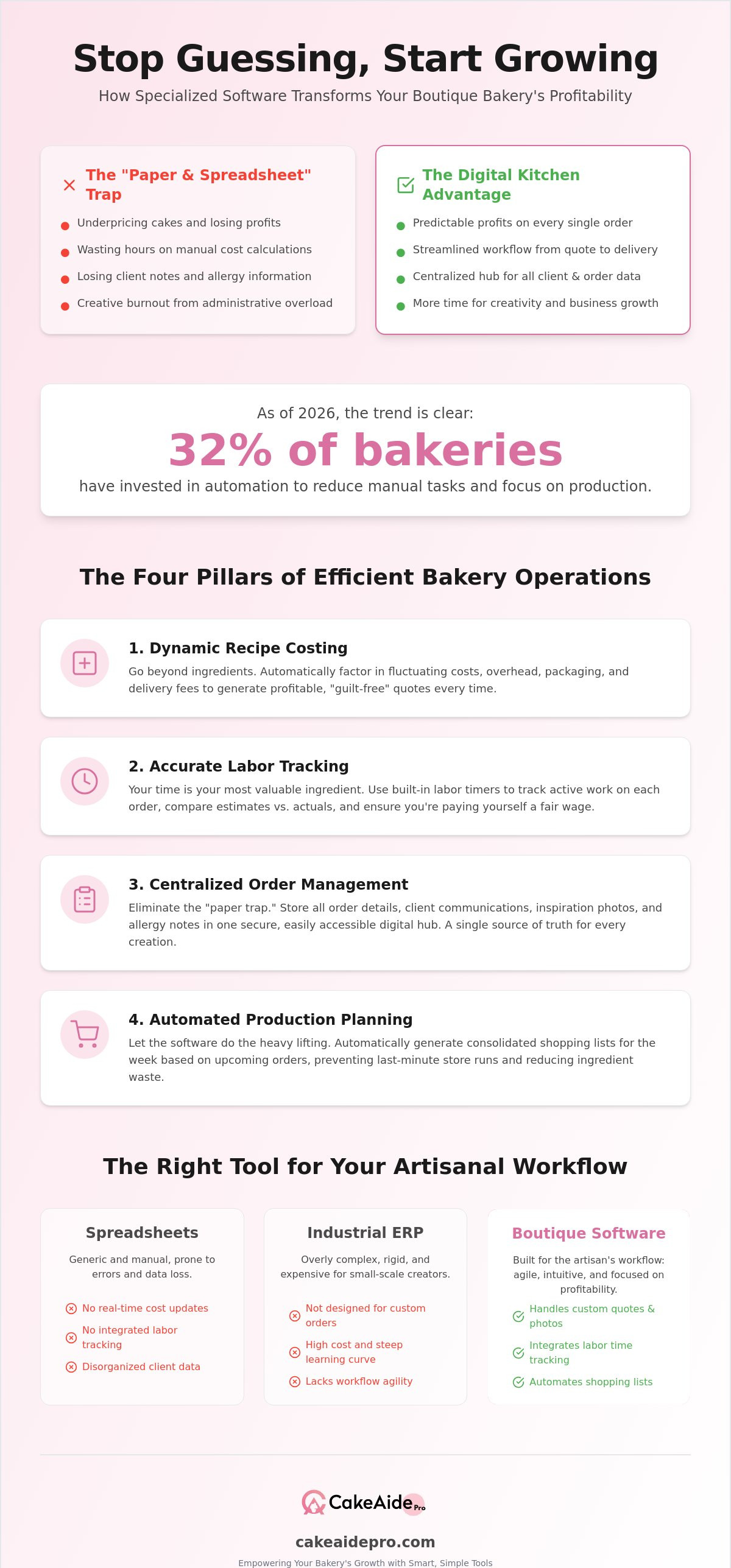
Build your business on a foundation of data rather than guesswork. To thrive in a competitive market, you must move beyond simply baking delicious treats and start mastering restaurant management principles that apply directly to the artisanal world. Profitability in a boutique setting isn't an accident; it is the result of four integrated pillars working in harmony to prevent data silos. Operational efficiency in a bakery context is the ability to reduce manual administrative tasks so effectively that you can focus entirely on production, a goal that has led 32% of bakeries to invest specifically in automation as of 2026. This is where bakery management software becomes your most valuable partner, especially when it offers mobile access that lets you check order details while your hands are still covered in flour.
Dynamic Recipe Costing and Quote Calculation
Precision starts with your ingredients, but it doesn't end there. True profitability requires you to factor in overheads, specialized packaging, and delivery fees for every single order. Many bakers fall into the trap of "guesstimating" prices, which often results in lost margins. Using a "Guilt-Free Quoting" method allows the software to handle the logic. When you input your core ingredient costs once, the system calculates the exact price point you need to stay profitable. It even generates automated shopping lists based on your weekly recipe data, saving you hours of manual preparation and preventing last-minute trips to the store.
Labour Tracking: Your Most Expensive Ingredient
Identify your true costs by acknowledging that your time is your most expensive asset. Most boutique bakers fail to pay themselves a fair hourly wage because they don't track the actual active time spent on intricate decorations or dough lamination. Specialized bakery management software solves this by using built-in labour timers. By tracking the real-time duration of each task, you can compare actual labor against your initial estimates. This data allows you to adjust future quotes with total confidence, ensuring your creative energy is always compensated fairly.
Client Relationship Management (CRM) for Repeat Business
Turn a one-time cake order into a lifelong client relationship. A robust CRM stores more than just contact info; it captures the personal details that drive repeat bookings. Automated reminders for anniversaries and birthdays allow you to reach out to clients exactly when they need you most, creating a professionalized experience that feels personal. When you store specific preferences and previous photo references in one central hub, you ensure consistent quality that builds trust. If you're ready to see how these pillars can stabilize your kitchen, you can start a 7-day free trial to explore these features firsthand.
Comparing Small Bakery Management Tools vs. Industrial Solutions
Choose a solution that fits your specific scale rather than one that promises every feature under the sun. For a solo entrepreneur or a small boutique team, the primary goal of bakery management software is to reduce complexity, not add to it. While industrial systems offer immense power, they often come with a learning curve that can stall your daily production. It's often more effective to adopt an "All-in-One" platform that handles everything from initial quotes to final delivery tracking. Using separate apps for inventory, invoicing, and scheduling creates data silos that eventually lead to errors and missed details.
Feature bloat is a real risk for small shops. If a platform has fifty buttons you'll never press, those buttons are just distractions. Focus on core functionality: a precise quote calculator, an order tracker with photo support, and a robust client database. Don't forget the importance of data portability. As tax season approaches, your ability to export your records in a CSV format is vital for your accountant and your own business backups. It ensures that you own your data, even if you decide to change systems in the future.
Feature Comparison: Boutique vs. Enterprise
Understanding the difference between these two categories prevents you from overpaying for tools you don't need. Boutique apps focus on the artist's workflow, prioritizing visual order tracking and custom quotes. In contrast, industrial Enterprise Resource Planning (ERP) systems focus on massive production efficiency and regulatory compliance for large chains. Here is how the features typically break down:
- Boutique Apps: Focused on quote calculators, visual order tracking, client CRM, and automated shopping lists.
- Industrial ERPs: Focused on lot traceability, multi-location logistics, EDI integration, and food forecasting.
Most small bakeries need tools that help them manage inventory effectively using methods like FIFO (First-In, First-Out) to handle perishable ingredients. If you aren't managing five different warehouse locations, an industrial ERP will likely feel like an anchor rather than a sail.
Cost of Ownership and ROI
Subscription models are generally the best path for growing businesses, as they avoid the heavy upfront licensing fees associated with enterprise software. Calculating your Return on Investment (ROI) is simpler than you might think. If a specialized bakery management software saves you just five hours of manual admin work every week, you've regained over twenty hours a month. What could you do with that extra time? You could develop new seasonal recipes, spend more time with family, or simply rest. The hidden cost of "Free" tools, such as basic spreadsheets, is the time lost to manual entry and the inevitable errors that occur when your business begins to scale.
Transitioning to a Digital Bakery Workflow: A 5-Step Guide
Moving your business from a paper-based system to a digital one can feel like a significant hurdle, especially when you're already juggling a full production schedule. However, the transition doesn't have to happen overnight. By following a structured approach, you can integrate bakery management software into your routine without disrupting your creative flow. This process is about building trust in your new system so you can eventually retire the flour-dusted notebook for good.
- Step 1: Audit your current "mess." Identify exactly where you're losing time or money. Is it the hours spent on manual shopping lists, or the profit lost to forgotten labor costs? Knowing your pain points helps you prioritize which features to use first.
- Step 2: Input your core data. Start by entering your most-used ingredients and their current costs. Once these are in place, build your basic recipe templates to unlock the power of automated costing.
- Step 3: Migrate your calendar. Move your upcoming order deadlines to the digital tracker. This gives you a visual overview of your production week and ensures no client details are missed.
- Step 4: Build your database. Set up your client profiles with past order history and photo references. This creates a professionalized experience that makes repeat bookings feel seamless.
- Step 5: Run a "Parallel Week." Use a 7-day free trial to manage your business using both your old paper logs and the new digital system. This allows you to verify the software's accuracy and build the confidence to fully switch over.
Managing Your Cake Shop Workflow for Efficiency
Success with a digital system depends on consistency. Establishing a "morning check-in" routine allows you to review your production tasks and shopping lists before you even turn on the oven. If you want to dive deeper into the logistics, read our guide on How to Build a Cake Shop Management System That Actually Works in 2026. Staying disciplined with data entry is particularly crucial during the busy wedding season, when the volume of custom details can easily lead to "information overload" if not captured immediately.
Unit Conversion and Global Standards
Modern baking often requires global flexibility. Whether you prefer metric or imperial units, your bakery management software should handle the conversion automatically. This is essential for international recipe testing and ensures that scaling a batch up or down never results in a calculation error. Additionally, keeping your digital records updated means your business is always tax-ready. You can quickly generate CSV exports for your accountant, ensuring that your financial reporting is as precise as your recipes. If you're ready to stop second-guessing your admin, start your free trial today and experience a calmer kitchen.
Empowering Your Bakery Growth with Cake Aide Pro
Success in the artisanal world requires more than just a talent for flavors; it demands a system that respects your time. Cake Aide Pro was designed by bakery industry professionals who understand the 2 AM baking grind and the specific anxieties of managing a custom order business. We've built this bakery management software to act as a digital mentor, guiding you through the logistical hurdles that often stifle creative growth. If you've ever felt like your business was managing you rather than the other way around, you're exactly who we built this for.
The Quote Calculator is perhaps the most transformative tool for those moving from a hobby to a profitable enterprise. It removes the emotional weight of pricing, allowing you to present professional quotes based on hard data. By integrating our bakery CRM for small shops, you can drive long-term loyalty without adding to your daily workload. These features ensure that every client feels valued, while you maintain the structure needed to scale your business with confidence.
Seamless Management from Phone to Web
Maintain total control of your kitchen whether you're at your desk or on the floor. Our mobile-first design allows you to manage orders on the go, making it easy to check a recipe or update a client's status in real time. You can store client photos and design inspirations directly within each order file, ensuring that no detail is lost during the production process. Choosing a subscription model means you always have access to the latest security updates and feature improvements, allowing your tech stack to evolve as quickly as the industry itself.
Your Partner in Profitable Baking
You deserve to be paid fairly for your talent, your precision, and your time. Adopting professional bakery management software changes how clients perceive your brand, positioning you as a premium professional rather than a casual hobbyist. This shift in perception often allows for higher price points and more selective bookings. If you're ready to reclaim your creative energy and stabilize your income, a simple change in workflow is the first step. Start your 7-day free trial of Cake Aide Pro today and discover how a streamlined admin process can lead to a more profitable and peaceful kitchen.
Scaling Your Creative Vision with Confidence
Transitioning to a digital workflow is the most significant step you can take toward long-term sustainability. You've seen how precision in recipe costing and a clear understanding of your labour hours can turn a chaotic kitchen into a predictable, profitable enterprise. By centralizing client data and automating shopping lists, you eliminate the mental clutter that often leads to burnout. This clarity allows you to focus on the artistry that inspired you to start your business in the first place.
Implementing specialized bakery management software isn't just about efficiency; it's about giving yourself the permission to grow. Designed by bakery industry professionals, Cake Aide Pro is used by home bakers and boutique shops globally to regain control of their creative process. With tools like our integrated Quote Calculator and Labour Timer, you can finally price your work with total authority. You have the talent and the drive to build something remarkable. Now, you have the digital foundation to support it.
Start your 7-day free trial and professionalise your bakery today. We're here to help you turn your passion into a polished, professional success story.
Frequently Asked Questions
Is bakery management software worth it for a home-based business?
Yes, investing in bakery management software is often the turning point that transforms a home-based hobby into a sustainable enterprise. For a solo baker, the most significant risk is underpricing due to "hidden costs" like utilities and cleaning time. A dedicated system ensures you capture every penny of overhead, allowing you to scale your business without sacrificing your personal profit margins.
Can I use bakery software to calculate my tax records?
You can certainly use these tools to simplify your financial reporting. Most professional platforms allow you to export your order history and ingredient expenses as a CSV file, which your accountant can then use for tax preparation. While the software isn't a replacement for full accounting tools, it provides the raw data needed to verify your earnings and deductible expenses with total precision.
How do I calculate the cost of my labour in a management app?
Calculating labour is as simple as setting your desired hourly rate and using a built-in timer during production. If you track the actual time spent on tasks like crumb coating or intricate piping, the software automatically adds that cost to the final quote. This method eliminates the guesswork that often leads bakers to pay themselves far less than a fair market wage.
Does bakery software include a shopping list generator?
Yes, automated shopping lists are a core feature of high-quality bakery management software. Once you confirm your orders for the week, the system aggregates all the required ingredients across every recipe. This process creates a single, organized list that prevents multiple trips to the store and ensures you never run out of a critical item mid-bake.
What is the difference between a bakery CRM and a simple spreadsheet?
A bakery CRM is a proactive tool designed to nurture relationships, whereas a spreadsheet is a static log of past events. A CRM allows you to store specific client preferences, photo references, and important dates like anniversaries. It enables you to reach out with personalized offers at exactly the right time, creating a professionalized experience that a manual spreadsheet simply cannot replicate.
Can I track my cake orders and client photos on my phone?
Absolutely. Modern management tools are designed with a mobile-first approach, recognizing that you spend most of your time in the kitchen rather than at a desk. You can upload inspiration photos, check order statuses, and verify delivery addresses directly from your smartphone. This flexibility ensures you always have the most current information at your fingertips, even when your hands are busy on the kitchen floor.
How does bakery management software help with repeat customers?
The software helps drive repeat business by automating the follow-up process that many busy bakers naturally forget. If you set up automated reminders for birthdays or wedding anniversaries, you can reach out to clients before they even start looking for another vendor. Storing their previous order history also makes re-ordering their favorite flavors a seamless, one-click experience for both parties.
Is it difficult to switch from a paper order book to a digital system?
While any change in routine requires a brief adjustment, the transition is remarkably manageable if you follow a structured plan. Starting with a parallel week where you use both systems allows you to build trust in the digital tracker without fear of losing data. Most users find that the time saved on manual calculations within the first month far outweighs the initial setup effort.
Frequently Asked Questions
Yes, investing in bakery management software is often the turning point that transforms a home-based hobby into a sustainable enterprise. For a solo baker, the most significant risk is underpricing due to "hidden costs" like utilities and cleaning time. A dedicated system ensures you capture every penny of overhead, allowing you to scale your business without sacrificing your personal profit margins.
You can certainly use these tools to simplify your financial reporting. Most professional platforms allow you to export your order history and ingredient expenses as a CSV file, which your accountant can then use for tax preparation. While the software isn't a replacement for full accounting tools, it provides the raw data needed to verify your earnings and deductible expenses with total precision.
Calculating labour is as simple as setting your desired hourly rate and using a built-in timer during production. If you track the actual time spent on tasks like crumb coating or intricate piping, the software automatically adds that cost to the final quote. This method eliminates the guesswork that often leads bakers to pay themselves far less than a fair market wage.
Yes, automated shopping lists are a core feature of high-quality bakery management software. Once you confirm your orders for the week, the system aggregates all the required ingredients across every recipe. This process creates a single, organized list that prevents multiple trips to the store and ensures you never run out of a critical item mid-bake.
A bakery CRM is a proactive tool designed to nurture relationships, whereas a spreadsheet is a static log of past events. A CRM allows you to store specific client preferences, photo references, and important dates like anniversaries. It enables you to reach out with personalized offers at exactly the right time, creating a professionalized experience that a manual spreadsheet simply cannot replicate.
Absolutely. Modern management tools are designed with a mobile-first approach, recognizing that you spend most of your time in the kitchen rather than at a desk. You can upload inspiration photos, check order statuses, and verify delivery addresses directly from your smartphone. This flexibility ensures you always have the most current information at your fingertips, even when your hands are busy on the kitchen floor.
The software helps drive repeat business by automating the follow-up process that many busy bakers naturally forget. If you set up automated reminders for birthdays or wedding anniversaries, you can reach out to clients before they even start looking for another vendor. Storing their previous order history also makes re-ordering their favorite flavors a seamless, one-click experience for both parties.
While any change in routine requires a brief adjustment, the transition is remarkably manageable if you follow a structured plan. Starting with a parallel week where you use both systems allows you to build trust in the digital tracker without fear of losing data. Most users find that the time saved on manual calculations within the first month far outweighs the initial setup effort.